Book Review: Samuel Bendeck Sotillos (2025). Psyche and the Sacred: Integrating Mental Health and Spiritual Well-Being. Boulder, CO: Sentient Publications. ISBN: 978-1-59181-350-7.

Book Review - Samuel Bendeck Sotillos (2025). Psyche and the Sacred- Integrating Mental Health and Spiritual Well-Being. Boulder, CO- Sentient Publications. ISBN- 978-1-59181-350-7 By Elnaz Zahed - Cover image

This review examines Samuel Bendeck Sotillos’s Psyche and the Sacred: Integrating Mental Health and Spiritual Well-Being (2025), a wide-ranging critique of the epistemological foundations of modern psychology and a sustained argument for recovering what the author calls a perennial “science of the soul.” Sotillos contends that contemporary psychology, shaped by Enlightenment secularism, scientism, and the dominance of biomedical and diagnostic paradigms, has severed itself from its original concern with the psyche as soul. The book draws extensively on the wisdom of Christian mysticism, Sufi metaphysics, Vedāntic philosophy, Buddhist psychology, and Indigenous cosmologies to demonstrate that the integration of mental health and spiritual well-being is not a novel innovation but a restoration of an older, cross-cultural anthropology.

The review highlights the book’s interdisciplinary and clinical relevance, especially its critique of the DSM/ICD frameworks, its reframing of the Enneagram and entheogenic practices within sacred traditions, and its challenge to the prevailing focus on symptom reduction at the expense of meaning and transcendence. It also notes limitations such as the book’s composite structure, thematic repetition, and lack of engagement with empirical outcome research in spiritually integrated psychotherapy. Nevertheless, Sotillos’s work is positioned as an important intervention in current debates on the decolonisation of psychology, the ethics of psychedelic therapies, and the need to recover metaphysical depth in therapeutic practice. The review argues that Psyche and the Sacred deserves the attention of clinicians, scholars of religion and psychology, and educators seeking to cultivate culturally and spiritually responsive approaches to mental-health care.
Discourse Analysis of Luqmān the Wise in the Works of Saʿdī of Shiraz

Sayyed-Sadr-al-Din-Safavi-Discourse-Analysis-of-Luqman-the-Wise-in-the-Works-of-Saʿdi-of-Shiraz-Transcendent-Philosophy-Journal-2025-vol-26-No37-pp-266-295-Cover-Image

This article examines the representation of Luqmān the Wise in the works of Saʿdī of Shiraz through the lens of Critical Discourse Analysis (CDA). The main objective is to demonstrate how Saʿdī employs the character of Luqmān as a medium for conveying moral and educational concepts, as well as for social critique. The analysis focuses on three dimensions: narrative structure, power relations, and linguistic strategies. In this context, the concept of ḥikma (“wisdom”) goes beyond mere knowledge: it encompasses insight, experience, and the proper application of knowledge for the attainment of virtue and human flourishing.

The study concludes that Saʿdī skilfully employs Luqmān as an ideological subject to promote practical ethics, critique power relations, and create a discursive balance between Sharīʿa and Sufism. In Saʿdī’s works, Luqmān is not merely a historical figure, but a living legend through which an ethics of resistance against tyranny and materialism is continually rearticulated. This discourse analysis thus uncovers the hidden layers of power, ideology, and resistance within Saʿdī’s writings.

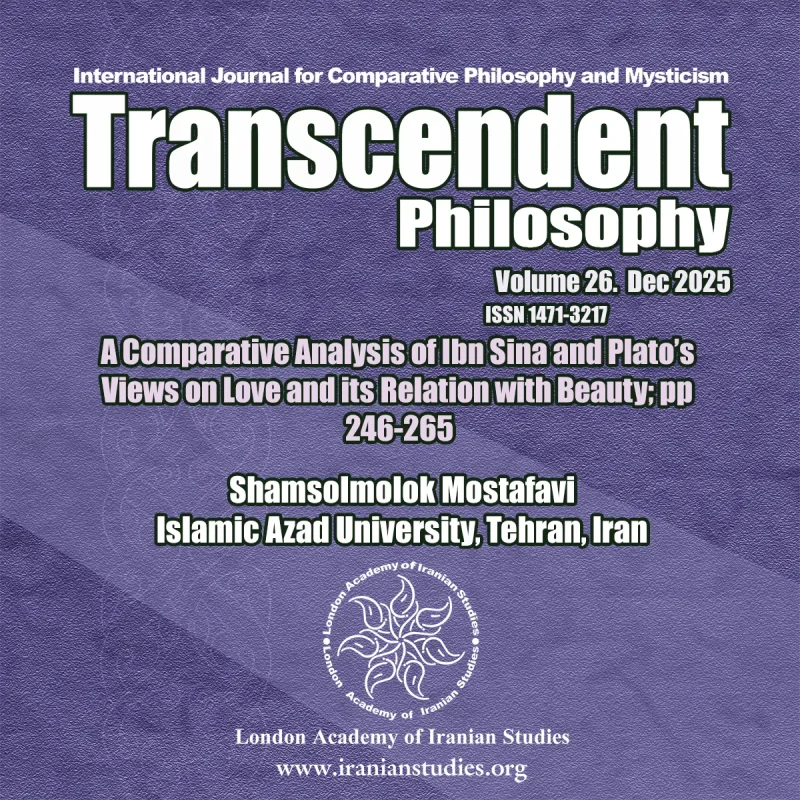
A Comparative Analysis of Ibn Sina and Plato’s Views on Love and its Relation with Beauty

Shamsolmolok-Mostafavi-A-Comparative-Analysis-of-Ibn-Sina-and-Platos-Views-on-Love-and-its-Relation-with-Beauty-Transcendent-Philosophy-Journal-2025-vol-26-No37-pp-246-265-cover-image.

Throughout the history of philosophy, many thinkers have reflected deeply on the nature of love, and some have achieved remarkable insights.
Plato, the renowned Greek philosopher, regarded the pursuit of the truth of love and its relation to beauty as a divine mission for philosophers. In his view, love is the desire for eternity, manifested in various levels of longing — from the lover’s attraction to the beloved, to the appreciation of beauty that progresses from the tangible to the rational, and ultimately to absolute beauty, which is the very essence of truth.

In comparison, Ibn Sina, the Peripatetic philosopher, in his Risala fi al-‘Ishq (Treatise on Love), considered love a natural inclination of all beings toward what is good and beautiful. For him, love also exists in levels, the highest of which connects with the supreme level of being — God, the Almighty, who is the manifestation of goodness and beauty.

This paper compares the perspectives of these two great thinkers on love and its relationship with beauty. It demonstrates that sublime truths reveal themselves to sincere seekers in similar forms, where speech becomes so unified that implication and statement may replace one another.

The Concept of Identity in Allameh Tabataba’i and Søren Kierkegaard

Maryam-Bayat-M.-Najafi-S.M.-Imam-The-Concept-of-Identity-in-Allameh-Tabatabai-and-Soren-Kierkegaard-Transcendent-Philosophy-Journal-2025-vol-26-No37-pp-220-245-cover-image

Identity has been a central theme in both Islamic philosophy and Western existential thought, though articulated through different conceptual frameworks. This article undertakes a comparative analysis of the notion of identity in the philosophy of Allameh Muhammad Husayn Tabataba’i (1903–1981), a leading contemporary Shiʿi philosopher, and Søren Kierkegaard (1813–1855), the Danish existentialist thinker. Drawing upon Tabataba’i’s seminal works—Bidāyat al-Ḥikma, Nihāyat al-Ḥikma, and Risālat al-Wilāya—the study explores how identity is rooted in metaphysical dependence on God, emphasizing the inherent poverty (faqr dhātī) of human existence and the path toward self-realization through divine proximity. In contrast, Kierkegaard’s writings—particularly The Sickness Unto Death and Fear and Trembling—present identity as an existential task of becoming a self before God, where despair and anxiety serve as stages toward authentic existence.

Through a systematic comparative methodology, the article highlights convergences between Tabataba’i’s metaphysical ontology and Kierkegaard’s existential theology, while also underscoring their divergences in epistemology, anthropology, and soteriology. The findings suggest that both thinkers envision true identity as inseparable from the divine, yet articulate distinct philosophical paths: one through metaphysical gradation of being, the other through existential faith and individual subjectivity. This dialogue not only deepens the understanding of Islamic and Western approaches to identity but also opens new possibilities for contemporary comparative philosophy and interfaith discourse.

Languages of the Self: Convergences in Approaches of Ibn ‘Arabī and Abhinavgupta

Muhammad Maroof Shah - Languages of the Self Convergences in Approaches of Ibn ‘Arabī and Abhinavgupta - Transcendent Philosophy Journal, 2025, vol 26, No37, pp 196-219 - Cover Image

This paper argues that Śaivism and Sufism, when approached through their mystical–metaphysical dimensions, transcend exclusivist theological boundaries and reveal a profound convergence of insight. Drawing on the metaphysical frameworks of Abhinavagupta and Ibn ʿArabī, it examines key notions such as Infinity, All-Possibility, Divine Relativity, and Māyā to uncover a shared vision of transcendental unity underlying their doctrinal diversity. The study shows that a properly metaphysical interpretation of these principles clarifies the Śaiva understanding of manifestation, divine self-limitation, and the problem of evil, while harmonizing apparently conflicting dualist, monotheist, and non-dualist readings. By recovering the traditional metaphysical foundations common to both traditions, the paper underscores the need for a comprehensive comparative study of Abhinavagupta and Ibn ʿArabī to illuminate the evolution of the Rishi–Sufi synthesis in Kashmir.